


What one of football’s biggest clubs can teach us about organisational structure, leadership capability and having the right people in the right roles.
Manchester United have changed managers, spent enormous sums on players, appointed new football executives and repeatedly attempted to rebuild the foundations of the club. Yet sustained success in the post-Sir Alex Ferguson era has proved remarkably elusive.
For supporters, the debate has become familiar. Is the manager good enough? Are the players of the required standard? Have the right people been appointed to over-see recruitment? Does the club have the right football leadership? And are those making the biggest decisions actually equipped to make them? These are legitimate questions. But perhaps there is a more fundamental organisational issue worth exploring.
What if Manchester United’s challenges run deeper than the quality of the players or the manager? What if the real question is whether the club has the right organisational structure, and the right leadership capability at every level?
This is where the principles of Levels of Work and Stratified Systems Theory offer a particularly interesting perspective. And the implications extend far beyond football.
01 The Ferguson factor: one man, multiple levels of responsibility
For 26 years, Sir Alex Ferguson was the defining figure in Manchester United’s football operation.
His responsibilities and influence extended well beyond selecting the team, developing tactics and managing players. He helped shape the club’s football philosophy, influenced recruitment, developed successive generations of players, built a culture of competitive excellence and maintained success through numerous squad transitions.
In many respects, Ferguson was managing far more than a football team. He was helping to run an entire football system.
He needed to deliver results on a Saturday afternoon while simultaneously thinking about the composition of the squad three or five years into the future. He needed to identify emerging talent, develop future leaders, manage established stars and ensure that the club remained competitive through successive periods of change.
These are fundamentally different types of work. Some require immediate operational decisions. Others involve integrating multiple functions, balancing competing priorities and anticipating longer-term organisational requirements. Ferguson’s technical knowledge of football was only part of the story. His success also reflected an ability to manage a remarkably broad and complex leadership mandate. When he retired, Manchester United lost an individual who had integrated a wide range of football leadership responsibilities over an extended period.
Replacing that contribution was always likely to involve more than appointing another talented coach.
02 Understanding Levels of Work: not all leadership roles are equal
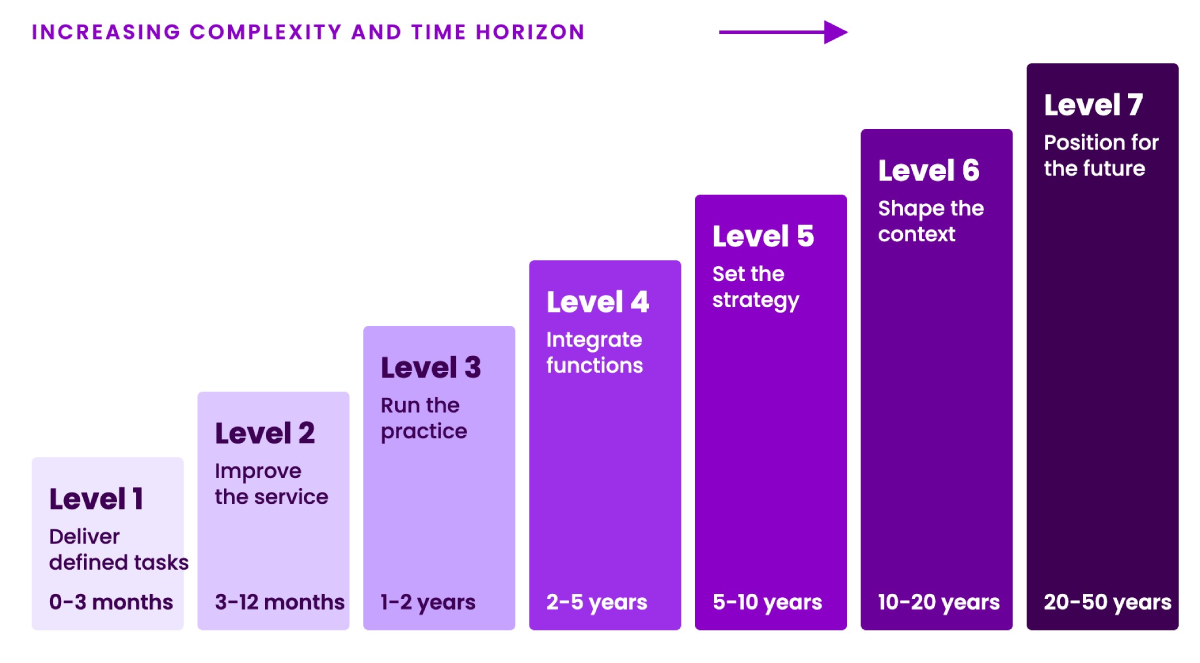
Levels of Work, drawing on Elliott Jaques’ Stratified Systems Theory, provides a framework for understanding the different levels of complexity within an organisation.
Different roles require different levels of cognitive complexity, judgement, integration and decision-making. A specialist may solve defined technical problems. A manager may coordinate several interdependent activities. A more senior leader may integrate multiple functions, reconcile competing priorities and establish conditions for longer-term success.
Importantly, the complexity of a role is not determined by its title, salary, experience or public profile. It is determined by the nature of the work and the decisions for which the role is accountable.
Equally important is the distinction between the complexity of the role and the capability of the person occupying it.
A role may require Level 4 complexity, but that does not automatically mean the individual appointed to it has the capability to operate effectively at that level.