



Organisations have access to more information about their people than ever before. Personality assessments provide insight into behavioural preferences, aptitude assessments indicate performance on particular reasoning tasks, and competency assessments help organisations understand workplace behaviours. There is, however, another important dimension that is often less well understood: capability.
Capability relates to an individual’s capacity to deal with complexity in their work. This can be particularly valuable when organisations are making decisions about leadership appointments, succession, career progression and the development of future talent.
The Modified Career Path Appreciation (MCPA) and MCPA SCAN are designed specifically to provide insight into this dimension. Both are grounded in Levels of Work theory and help organisations understand the level of work complexity an individual is currently capable of handling, together with their potential to operate at greater levels of complexity over time. Although they assess the same underlying construct, they are designed for different organisational populations and applications.
Understanding capability and where it fits in the talent picture
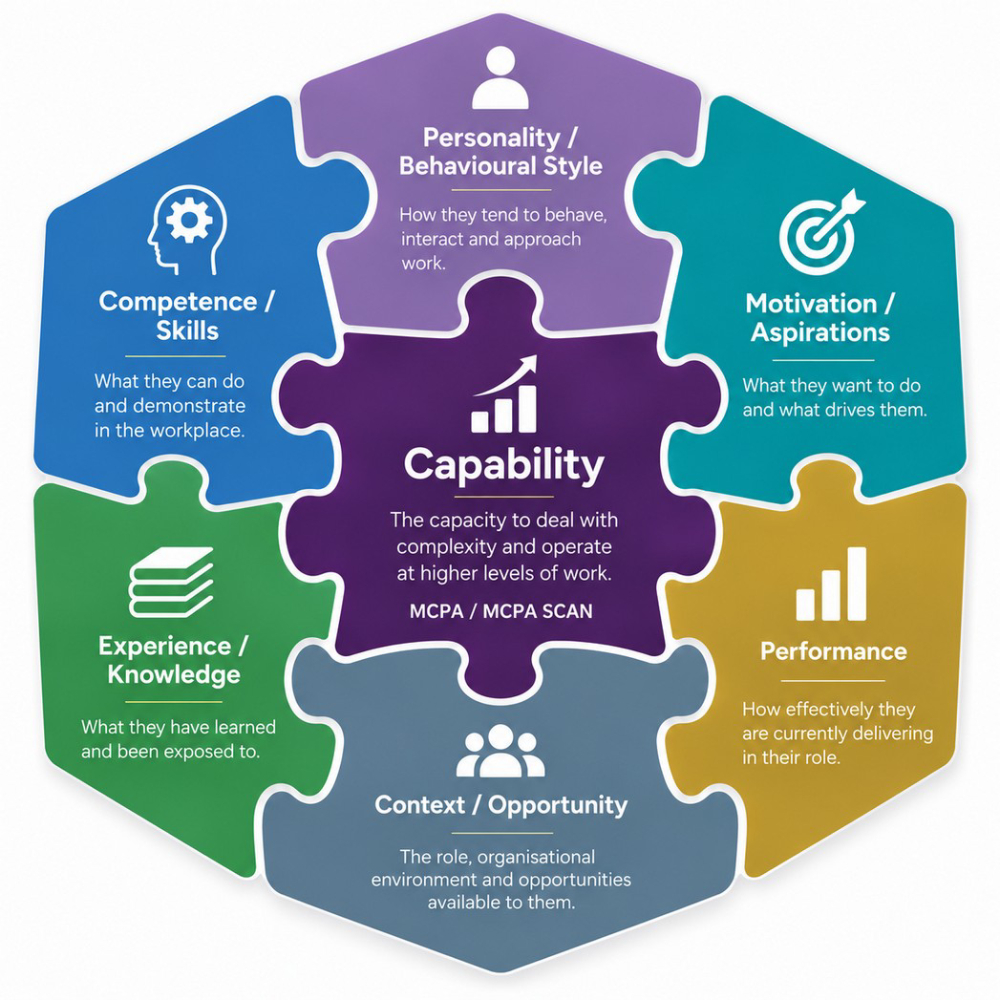
Every role requires an individual to process information, make decisions and solve problems. As roles become more senior, however, the complexity of this work changes.
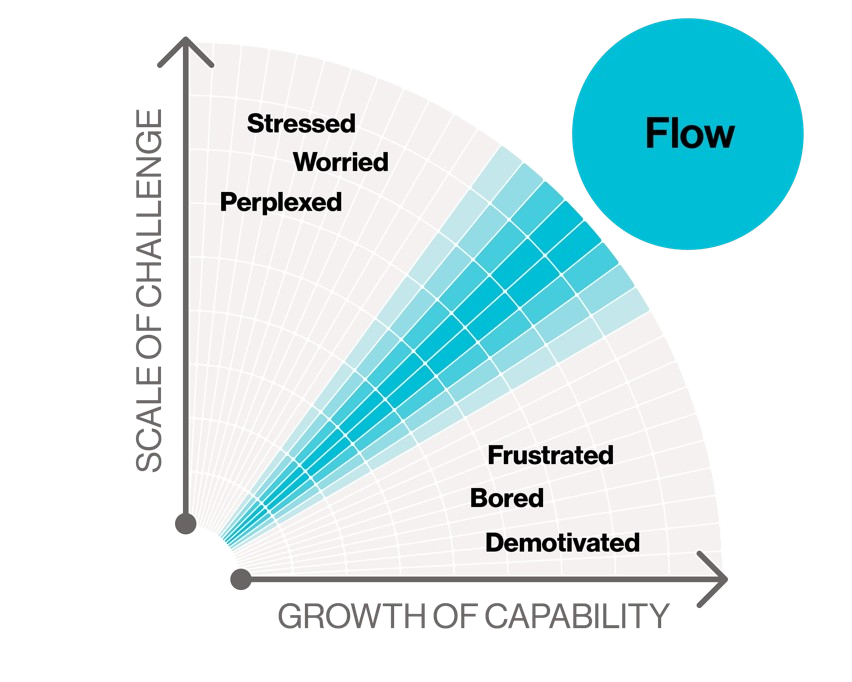
An operational role may require someone to apply established processes and resolve relatively immediate problems. At more senior levels, leaders may need to integrate multiple sources of information, work with greater ambiguity, consider longer time horizons and make decisions where cause and effect are less certain.
Capability describes an individual’s capacity to handle these increasing levels of complexity and uncertainty. It is different from intelligence, aptitude, personality or behavioural competence. The MCPA does not assess how much someone knows or how they are likely to behave. Instead, capability assessment provides insight into the level of complexity an individual is capable of handling in their work and how this may develop over time.
This distinction matters because capability is one part of a broader talent picture. An individual may have strong technical expertise, considerable experience and desirable behavioural characteristics, yet still find the complexity of a particular role challenging. Equally, someone may have the capability to operate at a significantly higher level than their current role requires.
For this reason, capability assessment is most valuable when considered alongside other information such as experience, performance, personality, behavioural competencies and motivation. It is not intended to replace professional judgement, but to provide an additional evidence base for better talent decisions.
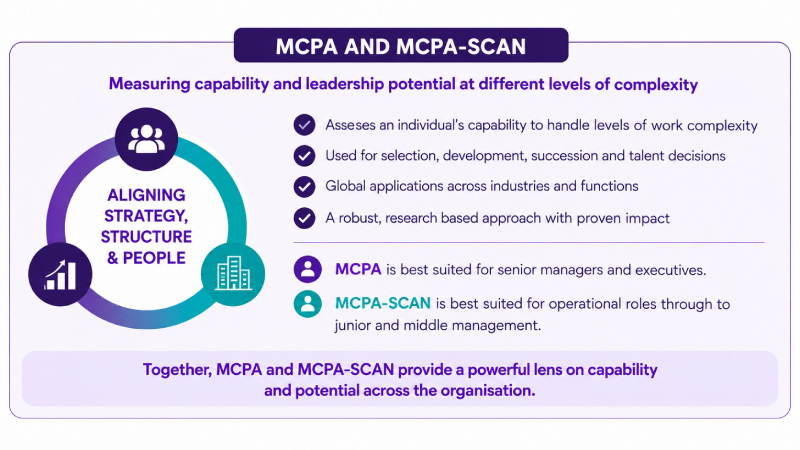
What does the MCPA measure?
The MCPA assesses an individual’s current level of capability and their potential to operate at greater levels of complexity in the future. It considers how an individual approaches problems, integrates information, develops solutions and works with uncertainty, relating these findings to different Levels of Work Complexity.
This enables organisations to consider questions such as:
- At what level of complexity is this individual currently most comfortable operating?
- What level of work are they likely to be capable of handling?
- How might their capability develop over time?
- Is there alignment between their capability and the complexity required by their current or proposed role?
The MCPA combines an online assessment with a validation interview conducted by a trained practitioner. This allows the findings to be explored and validated in greater depth, making the MCPA particularly valuable for senior leadership populations and decisions with significant organisational consequences.
What does the MCPA SCAN measure?
The MCPA SCAN assesses the same underlying concept of capability but through a more streamlined online process without the individual validation interview used in the full MCPA.
It is particularly useful where organisations need to assess larger populations efficiently or where the depth of the full MCPA is not required. The MCPA SCAN is generally best suited to employees working from operational through junior and middle management levels, while the full MCPA is particularly suited to senior managers and executives.
MCPA or MCPA SCAN: which should you use?
The two assessments are complementary rather than competing alternatives. The choice should be guided by the population being assessed, the complexity of the roles involved and the significance of the decisions the assessment will inform.
For an executive succession candidate, for example, the depth provided by the MCPA and validation interview would generally be appropriate. An organisation seeking to understand capability across a larger population of emerging managers may instead use the MCPA SCAN to identify patterns of capability and potential efficiently. Individuals identified for more senior opportunities can subsequently be assessed using the full MCPA where greater depth is required.
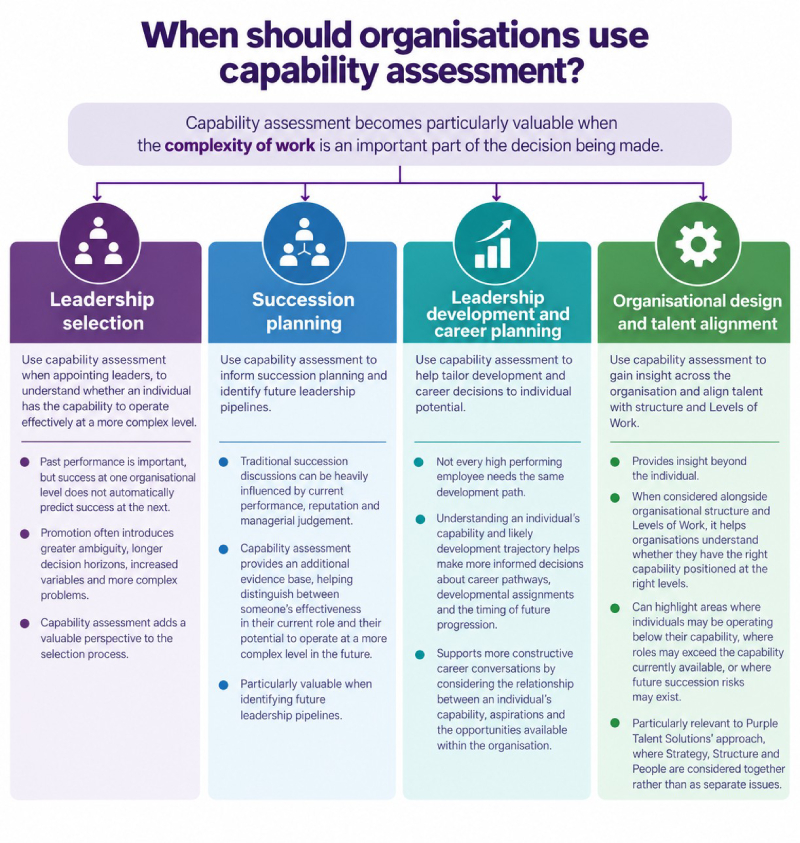
When should organisations use capability assessments?
Frequently asked questions
Understanding capability in context
The value of capability assessment lies not simply in identifying an individual’s current or future level, but in understanding what that information means in the context of the organisation. It can support more informed decisions about who to appoint, who to develop, where future leadership capability exists and where potential gaps may emerge.
The MCPA and MCPA SCAN provide complementary approaches to assessing capability across different organisational populations. When combined with other talent information and considered alongside organisational strategy and structure, they provide an additional perspective on both current capability and future potential.
Purple Talent Solutions works with organisations to apply the MCPA and MCPA SCAN across leadership selection, succession planning, talent development and broader organisational capability initiatives.
To find out more, explore our Capability and Leadership Potential Assessments or speak to the Purple Talent Solutions team about how capability assessment could be applied within your organisation.